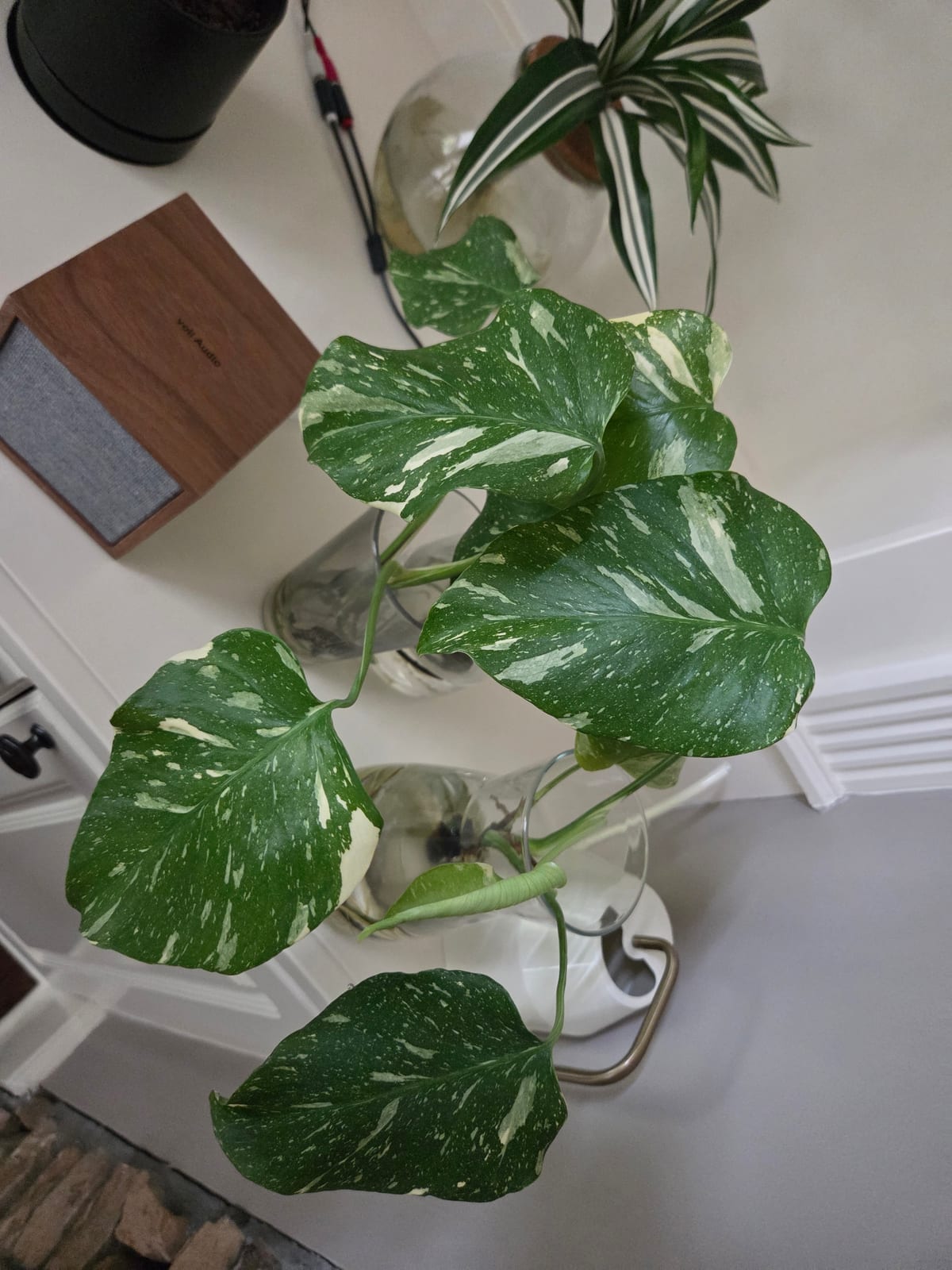
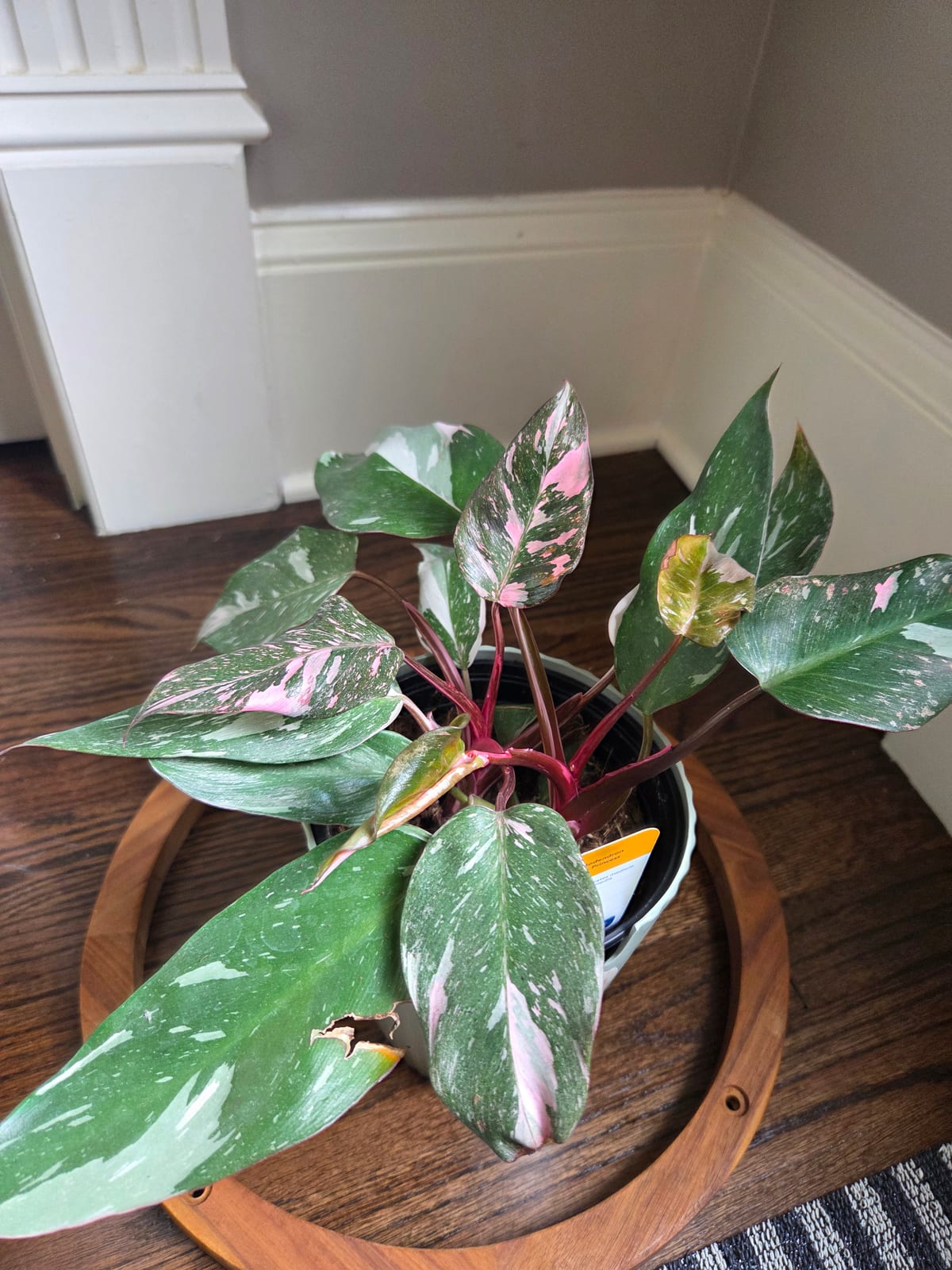
Grow journal · September 17, 2026
Week 9 — Wrong About the Waiting
Week 5 said the correct response to the Pink Princess was to do nothing at all. That was wrong, and the plant paid for the month it took to find out. Meanwhile eight avocados moved from water into soil and we can no longer tell which is which.
We skipped an entry. Week 7 does not exist. The last time we wrote anything down was August 21st, and it is now the middle of September.
Two things happened in that gap. One of them is the Pink Princess dying, and the other is eight avocados going into soil. They look unrelated. They are the same mistake.
What Week 5 said
The Week 5 entry was called Nothing to Do but Wait. It said the Pink Princess had been injured by its repot, that the fine roots doing the actual drinking had been lost in the move, and that the plant was crisping at the edges while its soil stayed damp because it could not drink. It concluded that the discipline was in not improvising — no more water, no feeding, no second repot. Just wait for a new leaf from the centre.
Week 3 had said the same thing two weeks earlier.
Both entries were wrong.
What was actually happening
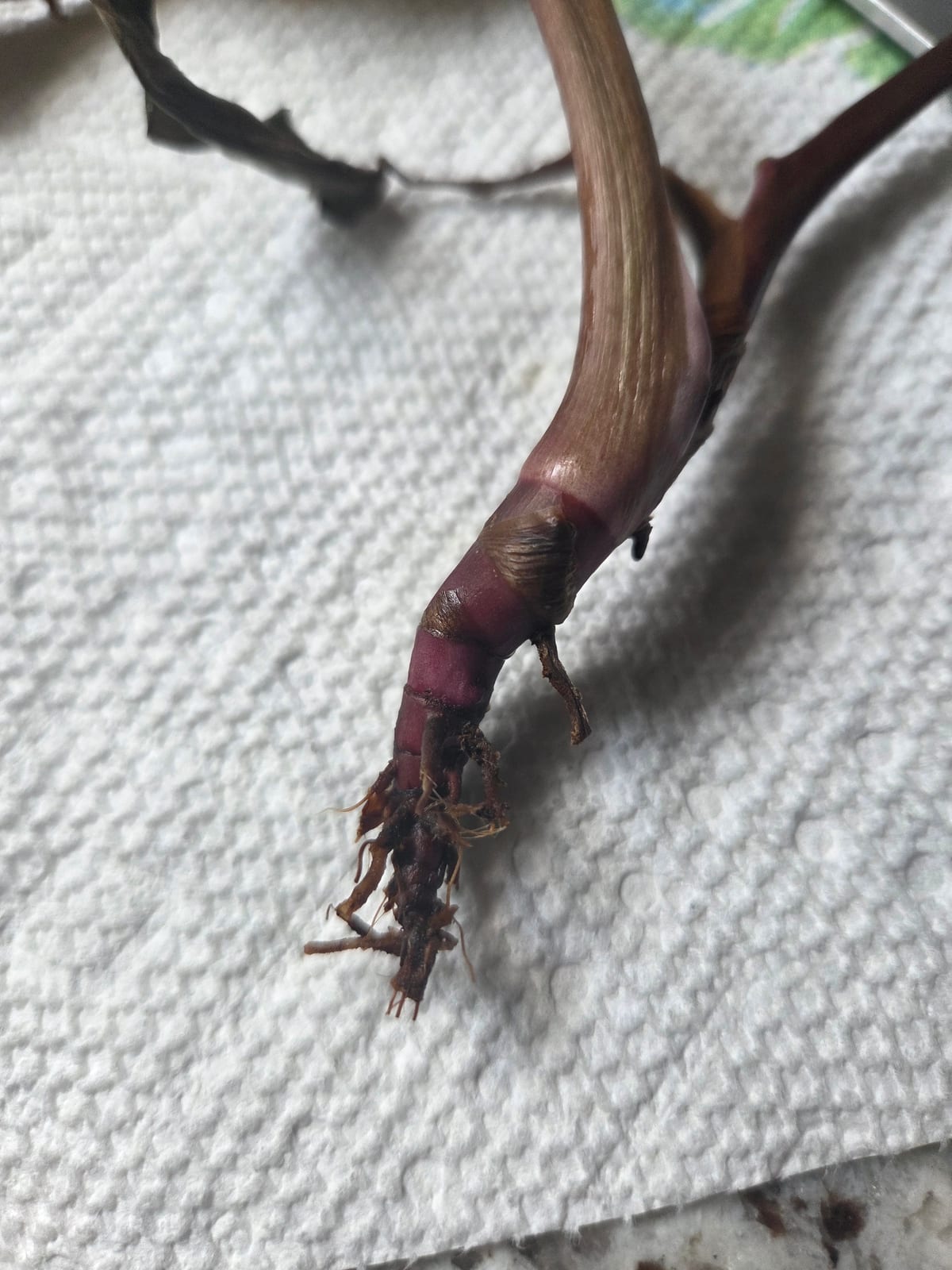
The plant came out of its pot this week. There were no roots left. Not damaged roots — no roots. What was there came apart under a thumb: the outer layer sloughed off and left the inner strand behind, thread-thin, the way a root goes when it has been rotting.
A root is a narrow core that carries water wrapped in an outer layer that absorbs it. The absorbing happens on the outside. Strip that away and what remains is a pipe with no opening, and it does not grow back.
The cause was not the repot injury. It was too much water. Four things said so once the plant was out of the pot and they were all in the container rather than in the leaves: a cup with no working drainage, dense general-purpose potting soil packed around the roots of a plant that climbs trees for a living, white mould across the soil surface, and lower leaves going yellow rather than brown.
The part that makes this worth writing down
Dry, crisp leaves look like thirst. They look exactly the same when the roots have rotted and cannot lift water. The plant is dehydrated either way. From above the soil, the two conditions are indistinguishable.
The treatments are opposites. Repot injury heals if you leave it alone. Root rot only continues. We read the symptom correctly and the cause backwards, and then we wrote an entry congratulating ourselves for the patience to do nothing, and then we did nothing for a month while the roots finished dying.
Week 5 also carried a photograph of pothos cuttings rooting in glass jars on a lower shelf, with a line about how they were a useful thing to have in front of you the same month a repot went wrong upstairs.
The jars were the answer. We photographed the answer, wrote a caption about the answer, and did not see it. The pothos roots were visible because they were in water behind glass. The Pink Princess roots were not visible because they were in soil, and so they could rot for a month without anyone knowing.
Where the plant is now
It is a cutting in a glass of water with no roots and no leaves.
Everything dead came off. The dried leaves, the dried sheath around the base, all of the old soil rinsed away, every dead root cut back flush. Then the base was sliced a millimetre at a time until the cut face came up clean, and the piece that came off had a bright, firm face of its own — which is how we knew the blade had passed through living tissue rather than stopping short in dead.
That last part cost us a wrong rule. The instructions we had written said to cut until the face came up white or pale green. A Pink Princess stem is full of anthocyanin; live tissue there cuts pink. Following our own rule would have meant slicing away a healthy stem looking for a colour it was never going to show. What actually matters is whether the face is even, moist, and free of brown flecks — and the offcut tells you more than the cutting does.
Water, now, for a specific reason: what killed this plant was a watering judgement, and a glass removes the judgement. There is also nothing to water into — with zero roots, bark or moss just dries out around a stem that cannot go looking for moisture.
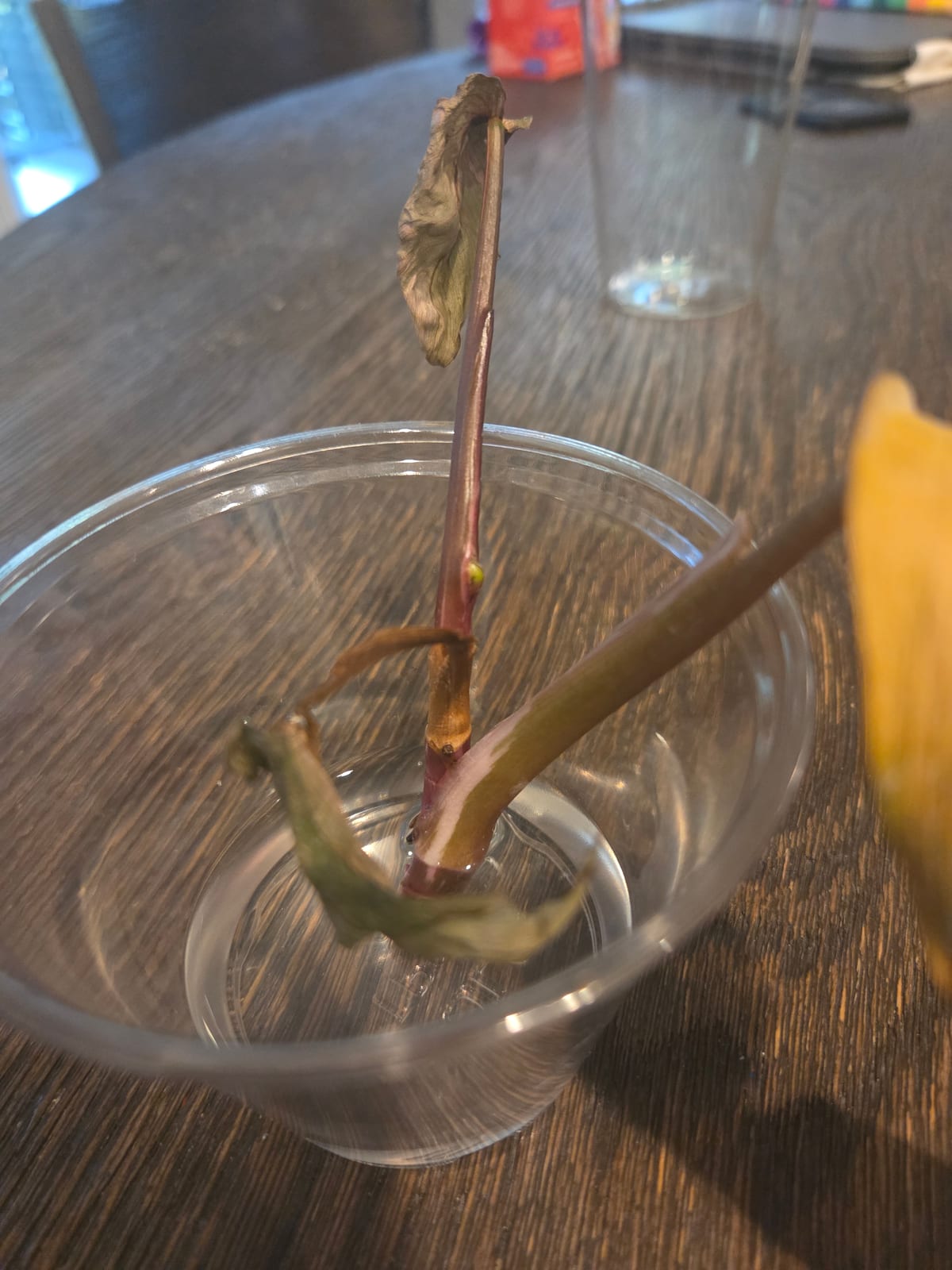
There is one live bud at a node, yellow-green and glossy, sitting above the waterline. It got visibly bigger over two days. A plant that is spending energy building a leaf is not a plant that is giving up. That is the only good news here and it is worth about what it sounds like: roots take three to six weeks with no leaves feeding the process, and a month of nothing happening is the expected reading rather than a bad one.
Odds are a little better than even. Firm base, live node, no soft rot. Against that: no roots, no leaves, and a cultivar whose pink tissue carries no chlorophyll and so contributes nothing while demanding to be built.
The app we built for the wrong problem
Week 5 contained a second admission, smaller and easier to miss. It sat in the caption under a before-and-after of the Pink Princess: the two photographs had been taken from different places — one looking down at a desk, the other from the side of a shelf — and the comparison was worth less because of it. We wrote that it was a lapse we should not have repeated.
We took that seriously. We spent the following weeks building a camera for it.
It shows the last photograph of that particular plant as a translucent overlay while you frame the next one, so matching a fortnight-old angle stops being a memory problem and becomes a matter of lining two images up. It keeps its photographs per plant, so the overlay is always the right one. It writes files named for the plant and the date. It runs in a phone browser, it costs nothing, and it is at ghost-cam.altair0622.workers.dev if it is useful to anyone else. It is a separate thing from this site and does not know this site exists.
It works, and we are glad we built it, and it is the smaller of the two problems that entry contained.
Week 5 noticed that our photographs of the Pink Princess were inconsistent, and we built a tool so that the next ones would line up. Week 5 did not notice that the plant in those photographs was dying of something other than what we had written down. Both were visible in the same entry. We solved the one about framing.
Eight avocados, and a bill for not labelling them
The other thing that happened in the gap: the avocado pits came out of water.
There were five on the windowsill in August, grown from kitchen scraps, which Week 3 explained as cheap practice at noticing what a plant is doing before it becomes obvious. Two of them by then had thick roots. Since August they have gone into soil in three rounds — two pits on the 26th of August, three more in mid-September, three more the day before yesterday — and more seeds are germinating in water behind them. It runs continuously now.
The first pair is struggling. Leaves browning from the edges in, some of them failing outright. At the same time the newest leaf on one of them is visibly larger than it was two days ago, which is the same signal the Pink Princess is giving and means the same thing: still investing.
We do not know why the leaves are browning. We thought dryness — three weeks since the only watering — until we held the cup up to the window and found the bottom third still dark and damp, which means the roots were never short. Salt is a candidate, because avocados are unusually sensitive to it and it burns exactly the leaf margins, and because watering in small amounts never flushes anything through. That is a candidate and not a finding. The test is to water until it runs out of the bottom and see whether the next leaf comes in clean.
Here is the part that cannot be fixed. Five pits sat in water in August and eight are in soil now, and none of them were ever labelled. There is no way to say which cup on the windowsill in August became which cup on the table today. We can reason that the two with thick roots were probably the two that moved first, five days later, because you transplant the rooted ones first — but probably is not a record.
So the before-and-after works for the windowsill and not for any individual plant. This is what this shelf did. Never this is what this seed did.
A strip of masking tape in August would have prevented it. There is no version of this where we recover it later.
What actually changed
Three things, all of them about being able to see.
Every plant gets a tag. Written on the pot in marker, permanent, never reassigned even if a cutting is promoted later — because photographs start carrying the name the moment it exists.
The pots are clear cups with the bottoms cut out, and that is not laziness. Held up to a window, a clear cup shows the whole soil column: pale and dry at the top, still dark at the bottom, with the perlite going opaque white as it dries and translucent again when it is wet. That is not a proxy for what is happening at the roots. That is what is happening at the roots. The Pink Princess died in an opaque cup.
We photographed both ends of the range — a cup that needs water, and the same cup ten minutes after watering. The question stops being does this look dry to me and becomes which of these two does this match.
That is the same idea as the overlay camera, arrived at from a different direction: stop asking yourself to remember, and put the thing you are comparing against in front of you.
None of this would have saved the Pink Princess by itself. Someone still has to look. But for a month nobody could have looked, because there was nothing to look at.
Next entry
- Whether the Pink Princess cutting puts out a root, or whether the base goes soft and this becomes the entry where we stop
- Whether the first avocados’ new leaves come in clean after a proper flush, which would point at salt without proving it
- The Thai Constellation, which we promised to tag in Week 5 and did not, and which has therefore gone another month with no way to say which leaf is new
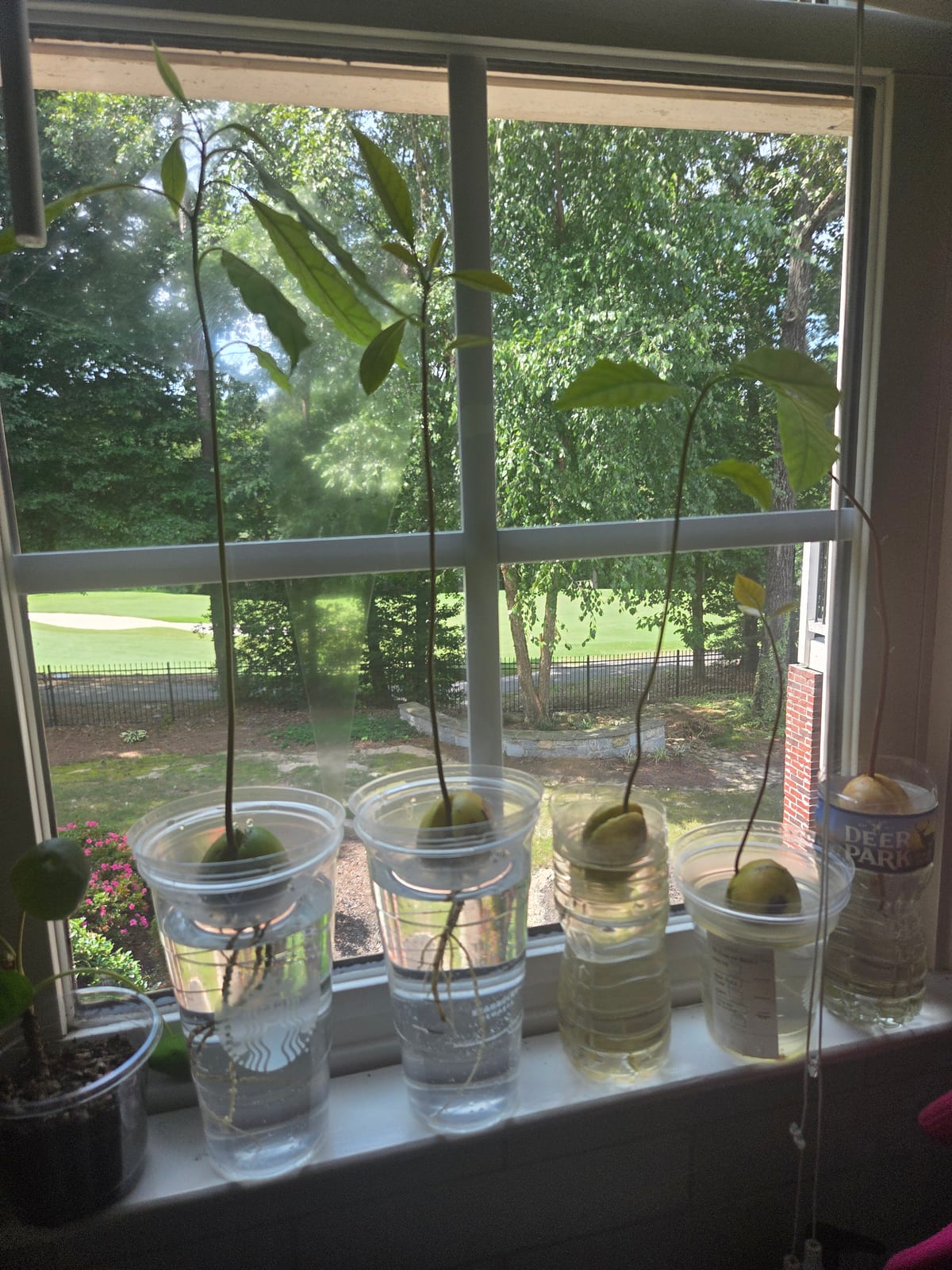 Four weeks ago, in water
 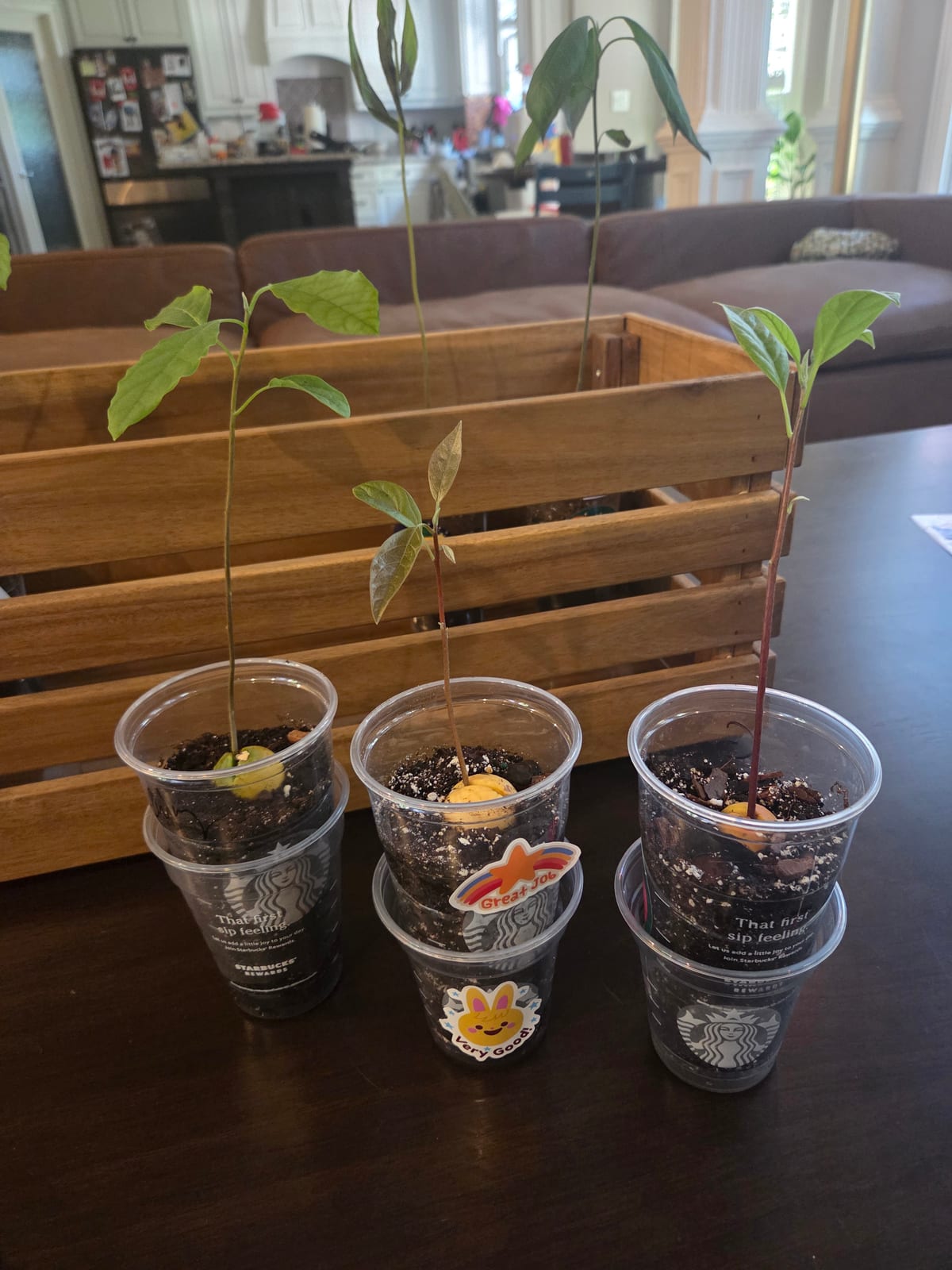 This week, in soil