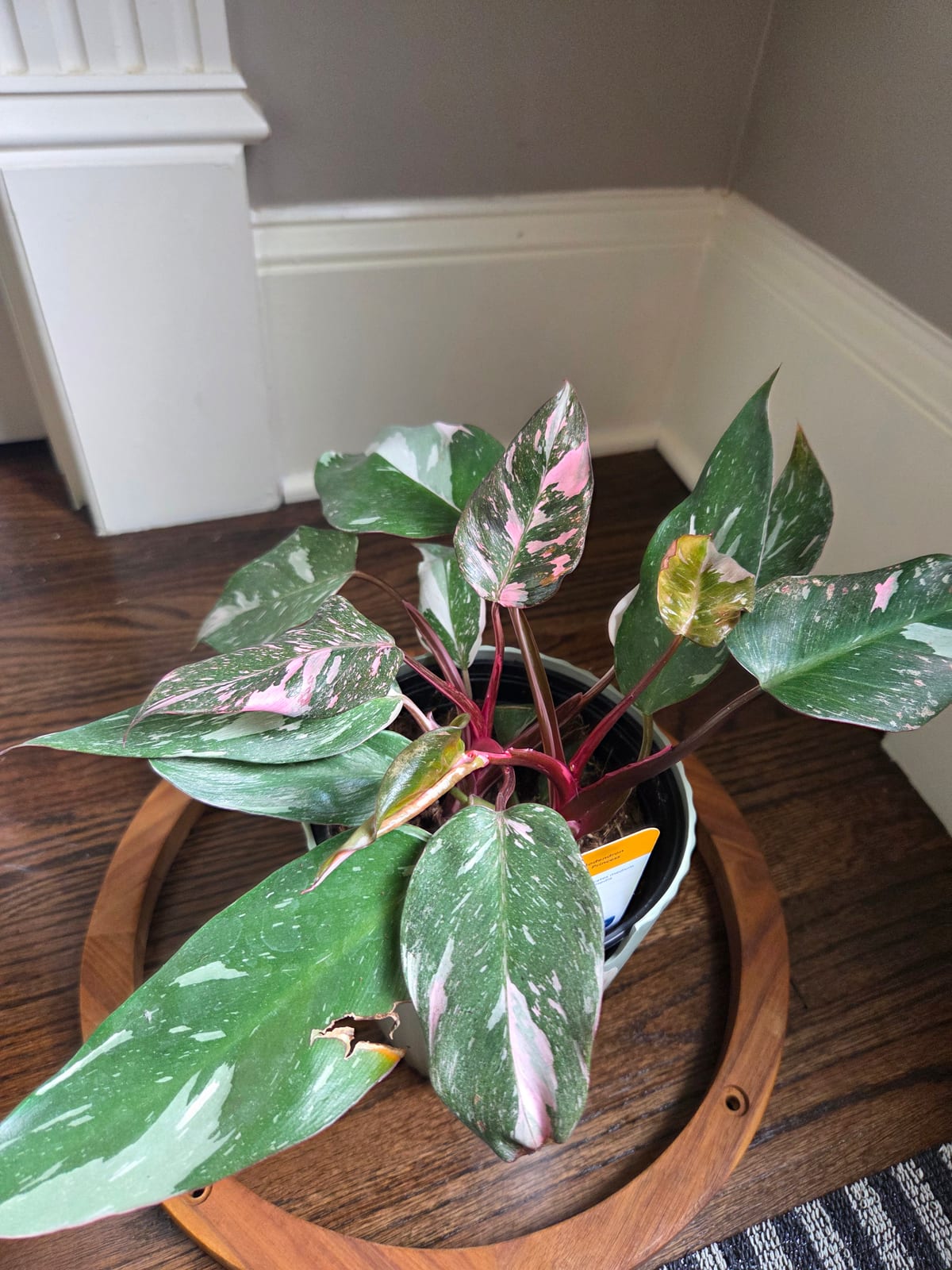
In propagation
Pink Princess
- Growing in
- Potted, chunky mix
- Variegation
- Pink and cream across green, on reddish petioles
- In our care since
- 2026-06
Pink Princess is the plant that taught a lot of people what unstable variegation means. The pink is not a fixed trait — it’s a chimera, a mutation carried in one layer of the growing tip, and the plant can lose it. Give it too little light and it reverts to plain green. Let it run the other way and it throws leaves that are almost entirely pink, beautiful and unable to photosynthesise, which the plant eventually abandons. Solid-pink plants sold cheaply as “Pink Congo” are treated with a chemical that forces temporary pink; they revert to green within months and never come back.
That is the plant in general. Ours, specifically, is in poor condition, and this page is not going to be written as though it isn’t.
Where it is now
It was repotted in early August. The roots looked sound coming out of the pot — no rot, no smell — and it went into fresh mix. The crisping started afterwards.
The reading we have stayed with since Week 3 is that the repot was the injury. The fine root hairs that do the actual drinking are what gets lost in a move like that, so the plant sits in damp soil and dries out anyway, because it cannot take the water up. Nothing since has contradicted that, and we are not going to dress it up as a mystery: the most likely cause of this plant’s decline is us.
So it is being left alone. No extra water — a shortage of water was never the problem. No feeding, no second repot into something better. Every one of those instincts adds a second injury to a plant already spending everything it has on rebuilding roots.
The only signal of recovery that means anything is a new leaf from the centre. Rehydrated old leaves are not a thing; the brown ones are not coming back. If the petiole bases go soft or dark at the soil line, that’s rot, and the answer stops being patience and becomes cuttings. That hasn’t happened.
The journal carries this week by week, including the weeks where it gets worse.
Next step. Get it through the repot injury described in the journal. Nothing else happens with this plant until a new leaf comes out of the centre.
Journal entries
- Week 5 — Nothing to Do but Wait · 2026-08-21
- Week 3 — The Pink Princess Is the One in Trouble · 2026-08-03